In the digital-first healthcare environment, the creation of a healthcare app is no longer an optional choice but a part of the strategy. A well-structured healthcare app will make life easier, as patients will be able to easily schedule appointments and, additionally, have secure communication with the providers, which will then improve patient outcomes and build trust. Custom digital solutions, typically based on platforms, such as custom crm systems and providers such as GetCustomCRM, are becoming increasingly important in providing seamless and patient-centric care to healthcare organizations that seek to modernize their operations.
This blog examines the essence of creating a healthcare app and the major features that patients and healthcare providers pay attention to the most.
Why Investing in a Healthcare App Business Makes Sense
The way a healthcare app of the modern time fills the gap between patients and providers is with their convenience, transparency, and access to medical services in real time. The quality of digital experience demanded by patients is growing to be comparable or even equal to what they get in the banking or online shops. To providers, apps lessen the workload, maximize the accuracy of data, and enhance long-term contact with patients.
Other than usability, a Healthcare App is also scalable. As the number of patients increases, the relationships, records, and communications can be effectively administered through digital workflows using integrated systems, including a custom CRM, in a single centralized location.
Key Features Every Healthcare App Should Have
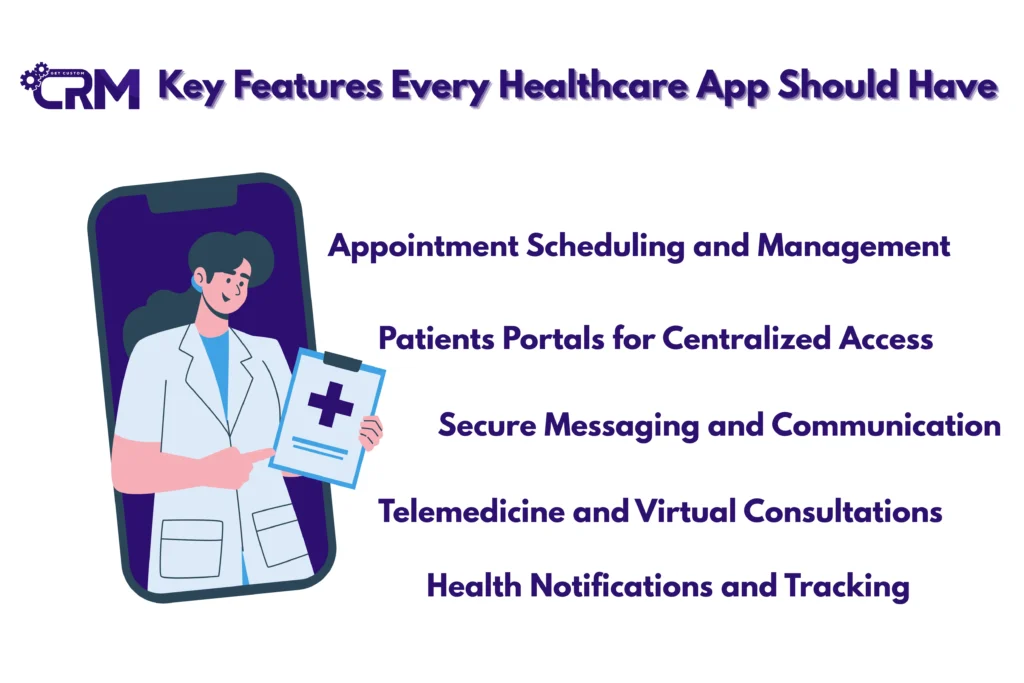
Appointment Scheduling and Management
Online appointment scheduling can be viewed as one of the most important Healthcare App features. Patients can check reservable time slots, book appointments, reschedule appointments, and have automatic reminders. This will reduce the no-show calls, save time and resources used with the staff, and also increase the efficiency of the clinic.
To the providers, appointment data may be synchronized with internal systems or a tailor-made CRM, allowing providers to plan resources and allocate staff better. Scheduling insights, when coupled with analytics, can be used to optimize their peak hours and patient flow.
Patients Portals for Centralized Access
Any successful healthcare app is based on a safe patient portal. It provides patients with access to their medical history, prescriptions, test results, treatment plans, and billing information in a single location.
On the side of the providers, patient portals decrease the number of repetitive questions and paperwork. Portals can also enable healthcare organizations to trace the patient journeys, customize communications, and provide more proactive care when combined with such systems as GetCustomCRM.
Secure Messaging and Communication
Secure communication through HIPAA is one of the must-have functions in a Healthcare App, and, therefore, encrypted messaging provides patients with an opportunity to communicate with doctors, ask follow-up questions, and get medical help without having to visit the doctor in person.
To the providers, secure communication enhances faster response time and a better relationship with the patient. A unified system of messages related to a personalized CRM will provide assurance that all communication will be recorded, tracked, and comply with the requirements.
Telemedicine and Virtual Consultations
Telemedicine has taken a particular shape in modern healthcare app solutions. Video consultations allow the providers to access remote patients, decrease the number of patients in clinics, and provide flexible care options.
Patients who have challenges in mobility or are tight are also beneficiaries of virtual visits. Telemedicine data can be stored, analyzed, and utilized to improve continuity of care when backed by the use of GetCustomCRM, a system that ensures the safe storage of this data.
Health Notifications and Tracking
An intelligent medical application will provide patients with the ability to track vital signs, medications, symptoms, and wellness goals. Follow-ups, appointments, and medication are automatically promoted by the use of automated notifications, enhancing adherence and health outcomes. These insights allow data-driven decisions on the side of providers. Once health tracking information is combined with a custom CRM, clinicians are able to identify trends, intervene at an early stage, and tailor treatment plans.
Benefits of Healthcare App for Patients
The convenience and control that a Healthcare App provides are most beneficial to the patients. They are able to take charge of their health at any time and place without necessarily having to spend a good deal of time waiting and filling in paperwork. Trust in records access leads to trust in care delivery, whereas confidence in care delivery is created through secure communication.
Also, healthcare apps enable patients to become active participants in their health process. Individual dashboards, alerts, and interactive aids ease healthcare and reduce stress levels.
In the case of healthcare providers, a healthcare app saves time on operations and lessens administrative overhead. Robotic processes liberate employee time, and teams are promoted to concentrate on patient care and not labor.
Along with other solutions, such as GetCustomCRM, providers obtain potent instruments of patient relationship management, monitoring, and long-term engagement tactics. The outcome is an increase in efficiency, compliance, and patient satisfaction.
The Role of Custom CRM in Healthcare App Development
With a custom CRM in support, a Healthcare App has much more strength. A custom CRM is tailored to healthcare processes, regulatory, and patient interactions, unlike generic systems.
Some such solutions as GetCustomCRM promote a seamless linkage of front-end application capabilities and back-end data handling. This guarantees safe management of sensitive data, real-time access, and expansion with the opening of digital services by the healthcare organizations.
Future Proofing Healthcare With the Right App Strategy
As healthcare is changing, it will determine competitive advantage by using digital solutions. Having an attractive healthcare app makes organizations capable of adapting fast, being innovative, and providing uniform and quality care.
Discussing the most important features, including the ability to make appointments, patient portals, secure communication, and CRM integration, healthcare businesses will be capable of creating apps that benefit patients and providers.
FAQs
What is a healthcare app, and why is it worthwhile to modern healthcare providers?
Healthcare App is an app that helps to save time, improve patient care, and minimize the work of administration by digitalizing the central healthcare processes.
What is the benefit of a custom CRM to a healthcare app?
The use of a custom CRM increases the level of care coordination and scalability by managing patient data, communicating on a one-to-one basis, and seamlessly incorporating app functionality.
Is secure communication a required feature in a healthcare app?
Yet, the privacy of patient data and adherence to the healthcare privacy policies require safe and careful communication.
Is GetCustomCRM compatible with a healthcare app?
Yes, GetCustomCRM can be customized and combined to facilitate healthcare application operations, patient management, and data protection.